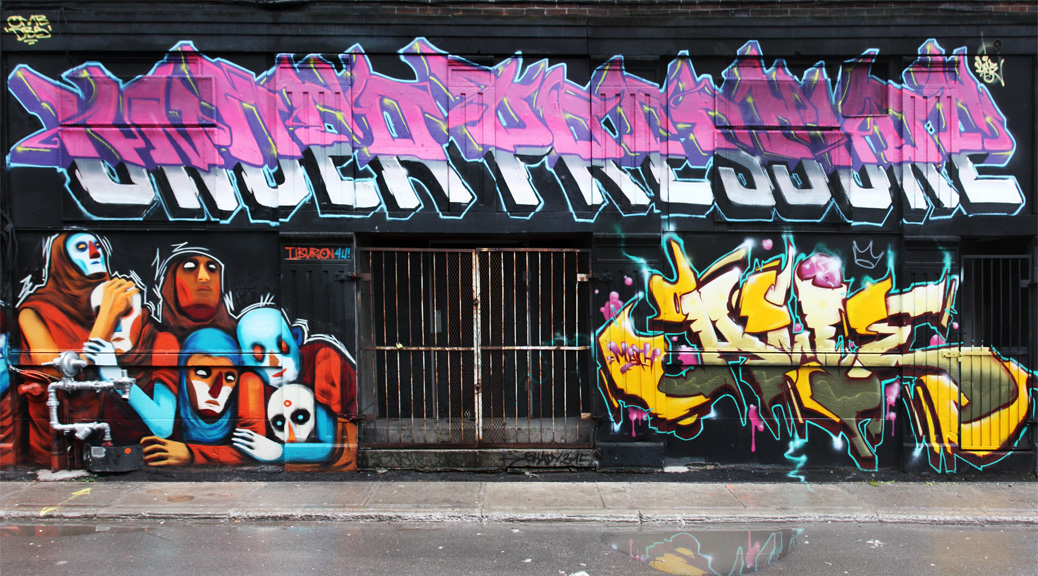
Serna (top), Asyne (middle), Minus Two (bottom letters) and Rouks (bird) for the 2016 edition of Under Pressure
Serna (top), Asyne (middle), Minus Two (bottom letters) and Rouks (bird; from larger piece, see below)
Rouks (woman), Lapin (head dress), Speak (feather), Capes (feather), Eskae (feather) and Sirvis (top) for the 2016 edition of Under Pressure
Rouks (woman and bird), Lapin (headdress) and Sirvis (top). If you look closely, you’ll see that the feathers on the woman’s headdress are actually graffiti letters by Speak (top feather), Capes (middle feather), Eskae One (bottom feather).
123Klan wall for the Under Pressure 2016 festival, featuring guests Mark Esprit (top left) and Zek (top right)
123Klan wall featuring Scien (bottom left) and Klor (bottom right), plus guests Mark Esprit (top left) and Zek (top right)
Under Pressure 2016 wall featuring Hsix (bottom left), Monk.e, Sermob, Bryan Beyung and les Hommes de Lettres (top)
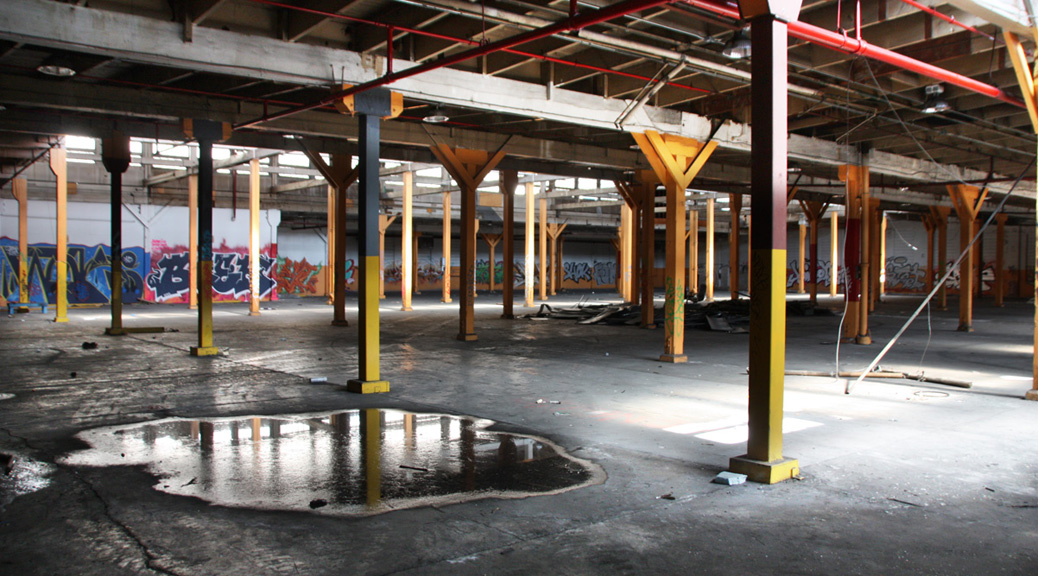
The Transco will probably be remembered as one of the greatest graffiti galleries in Montreal because of the size as well as the quality of the collection that was created within its walls. Rarely before had our city seen so many pieces of quality graffiti in one place. The collection of works which came to life inside the Transco was impressive in size because of the sheer dimensions of this warehouse complex (40 000 square meters), but also in quality because the building was demolished before lack of available free walls forced writers to go over each other’s works, and before the arrival of too many writers of lesser talent.
This huge warehouse, taking up most of the block within the streets St-Laurent, Chabanel, Esplanade and Louvain in today’s fashion district, started off as a military complex. It was built in 1943 by the Canadian Defense and was originally used for parachute packing for the army. After the war ended it served as an administrative office of military equipment. In the 1950s it was sold to private interests. Before its doors closed at the very beginning of 2013 it had served for a number of years as a distribution centre for the Transco Plastic Industries Inc. For over two years following its closing, the complex seems to have been visited only by urbex photographers and by an ex-employee who would squat there on and off. Around the end of May 2015 the RCD crew discovered the place with its huge rooms and thousands of square meters of virgin walls. For a few weeks they were the only ones in there, until some point into July when the SIK crew arrived. They first made it onto the roofs where they left a bit of art, then soon enough found a way in.
Because the site was easily accessible and many entryways into the buildings had been created, the gallery developed very quickly and most of the collection was created from August to November 2015. An impressive number of Montreal as well as visiting writers checked the place out at least once during that period. The place has even been used for fashion photography and for the filming of music videos. At the end of November 2015 the owners had a fence put up around the complex. That, with the arrival of winter, brought activity to a near-standstill. But the existence of a few secret entryways and the mellowness of the 2015-2016 winter have made it possible for the more dedicated writers to keep on creating there and for graffiti fans such as myself to keep on documenting the evolution of the Transco’s impressive collection.
In February 2016 teams arrived on the premises to prepare the buildings for demolition. They started by emptying the place of anything that may have still been useful and removed the asbestos inside its walls. Demolition started in the middle of March and at the end of July nothing was left of one of Montreal’s greatest graffiti galleries but a few piles of debris waiting to be cleared out.
My image gallery for the Transco features over 400 photos, mainly burners with a selection of throws and tags, plus a few general shots of some of the rooms. Because of its size, I had to split it up into 4 sections:
La Transco passera probablement à l’histoire comme étant une des plus grandes et des meilleures galeries de graffiti que Montréal aura connues. Notre ville avait rarement vu une aussi impressionnante quantité et qualité d’oeuvres de graffeurs en un seul endroit. La collection qui s’y est développé s’est démarquée par sa taille, étant donnée la superficie de ce complexe de salles et d’entrepots (40000 mètres carrés), mais aussi par sa qualité puisque l’endroit a été rasé avant que le manque d’espace ne pousse les graffeurs à passer par-dessus les oeuvres des autres artistes, et avant l’arrivée d’une trop grande quantité de graffeurs de moindre talent.
Cet immense complexe d’entrepots, situé à l’intérieur du quadrilatère délimité par les rues St-Laurent, Chabanel, Esplanade et Louvain dans le quartier de la mode, a d’abord été un complexe militaire. Il a été construit en 1943 par la Défense Nationale et a originellement servi à l’emballage de parachutes pour l’armée. A la fin de la guerre il a été converti en centre de gestion d’équipement militaire. Il est passé à des intérêts privés dans les années 1950. Au cours des années précédant sa fermeture au début de 2013, le complexe servait de centre de distribution pour les Industries de Plastique Transco Inc. Pendant plus de deux ans suite à sa fermeture l’endroit semble n’avoir été visité que par des photographes d’urbex ainsi que par un ancien employé qui y squattait à temps partiel. Vers la fin de mai 2015 le RCD crew a découvert l’endroit avec ses énormes pièces et ses milliers de mètres carrés de murs vierges. Ils ont été les seuls visiteurs jusqu’à ce que le SIK crew d’Ahuntsic découvre aussi l’endroit en juillet 2015. Ces derniers sont d’abord arrivés par les toits, y ont fait quelques pièces, puis ont éventuellement découvert une voie d’entrée.
Le site étant relativement facile d’accès et plusieurs voies d’entrée ayant été créées, la galerie s’est ainsi très rapidement développée et l’essentiel de la collection s’est constituée au cours des mois d’août à novembre 2015. Une très grande quantité d’artistes s’adonnant au graffiti à Montréal y est passée pendant cette période. Des équipes sont même venues y filmer des vidéos ou y faire de la photo de mode. Vers la fin de novembre les propriétaires du complexe ont cloturé l’endroit et l’hiver est arrivé, ce qui a ralenti l’activité considérablement. Mais l’existence de points d’accès demeurés relativement secrets et la clémence de l’hiver 2015-2016 ont permis aux plus tenaces de continuer à venir y pratiquer leur art et aux amateurs de graffiti tel que moi de continuer à documenter l’évolution de cette incroyable collection.
En février 2016 sont arrivées des équipes ayant le mandat de préparer l’édifice à être démoli. Celles-ci ont d’abord vidé le complexe de ce qui y avait été laissé et ont retiré l’amiante de ses murs. La démolition a débuté au milieu du mois de mars et à la fin juillet il ne restait plus rien d’une des plus grandes galeries de graffitis que Montréal a connue.
Ma galerie-photo pour la Transco contient plus de 400 pièces, principalement des graffitis burners avec une sélection de quelques pièces plus rapides, plus quelques photos générales de l’endroit. Etant donnée sa taille, j’ai dû diviser la galerie en 4 sections:
This post brings together photos of various artistic creations from the MTL En Arts festival which took place from June 29th to July 3rd this year. The event was put together mainly for artists to sell their creations, but I am only posting here the free public art curated by the people behind the festival. These include
the sidewalk panels on Amherst between Ste-Catherine and Robin
the flowerpots on Amherst between Ste-Catherine and René-Lévesque
the wheatpastes on the boarded doors and windows of the old Club Sandwich restaurant/hotel complex
Cet article présente une gallerie-photo des oeuvres créées dans le contexte de l’édition 2016 du festival MTL En Arts qui a eu lieu cette année du 29 juin au 3 juillet. Le but de l’événement est de donner aux artistes une opportunité de vendre leurs créations, mais ce qui est présenté ici ne sont que les oeuvres publiques gratuites créées dans le contexte du festival. Celles-ci incluent
les panneaux sur les trottoirs de la rue Amherst entre Ste-Catherine et Robin
les pots de fleurs sur Amherst entre Ste-Catherine et René-Lévesque
les collages sur les portes et fenêtres placardées de l’ancien complexe restaurant/hôtel Club Sandwich
Amherst panels
Here are the 14 panels installed on Amherst between Ste-Catherine and Robin a few weeks ahead of the festival.
Voici les 14 panneaux installés sur Amherst entre Ste-Catherine et Robin quelques semaines avant la tenue du festival.
Waxhead on sidewalk panel on Amherst for the 2016 edition of the MTL En Arts festival
Over a dozen huge flowerpots were installed on Amherst between Ste-Catherine and René-Lévesque and painted by various artists a few weeks before the festival. In keeping with the purpose of this blog, I have only selected to show the works of street artists and other artists who have been known to do public art.
Une douzaine ou peut-être une quinzaine de grands pots de fleurs ont été installés sur Amherst entre Ste-Catherine et René-Lévesque et peints par divers artistes quelques semaines avant la tenue du festival. La galerie ci-dessous n’inclut que les oeuvres des artistes connus dans le monde du street art et autres artistes participant régulièrement à des événements artistiques publics.
Cryote on Amherst flowerpot for the 2016 edition of the MTL En Arts festival
During the event, the boarded doors and windows of the Club Sandwich restaurant/hotel complex, usually covered with ad posters, were plastered with wheatpastes from various artists. Again, in keeping with the purpose of this blog, I have only selected to show the works of street artists and other artists who have been known to do public events before.
Pendant la tenue du festival, les portes et fenêtres placardées du complexe hôtelier Club Sandwich, habituellement recouvertes d’affiches publicitaires, sont devenues le canevas pour les collages d’une sélection d’artistes. La galerie ci-dessous n’inclut que les oeuvres des artistes connus dans le monde du street art et autres artistes participant régulièrement à des événements artistiques publics.
Miss Me wheatpastes on the boarded Club Sandwich hotel complex for the 2016 edition of the MTL En Arts festival
Spudbomb (left), Borrrris (right) and WhatIsAdam (far right) wheatpastes on the boarded Club Sandwich hotel complex for the 2016 edition of the MTL En Arts festival
This article features the new murals created during the 2016 edition of Mural Festival as well as the other temporary art found on the site (St-Laurent between Sherbrooke and Mont-Royal) while it was closed to traffic (June 9th to 19th).
Five earlier Festival murals have been replaced with new ones this year. These are the sponsored one by Bicicleta Sem Freio and the 4-Tin mural from the 2015 edition, the Alexis Diaz one from the 2014 edition, the LNY mural from the 2013 edition, as well as the Ashop mural done last autumn because the wall was not ready on time for last year’s edition.
You may want to check out this walking tour map connecting all Mural Festival creations and other major murals in the area. It starts from ‘mural central’ behind the LNDMRK offices, goes up St-Dominique and the eastern side of St-Laurent then down Clark and the western side of St-Laurent.
Cet article présente les nouvelles murales créées dans le cadre de l’édition 2016 du Festival Mural ainsi que les oeuvres temporaires trouvées sur le site (St-Laurent entre Sherbrooke et Mont-Royal) pendant la tenue de l’événement (9 au 19 juin).
Cinq murales ont été remplacées par de nouvelles cette année: celles de Bicicleta Sem Freio et de 4-Tin produites pour l’édition 2015, celle d’Alexis Diaz produite dans le cadre de l’édition 2014, celle de LNY datant de l’édition 2013 ainsi que la murale commanditée d’Ashop produite l’automne dernier sur un mur qui n’était pas prêt à temps pour le festival.
Vous êtes invités à jeter un coup d’oeil à cet itinéraire pédestre connectant toutes les murales produites dans le cadre de toutes les éditions du Festival ainsi que les autres créations majeures dans le même quartier. Le tour débute à la ‘place des murales’ derrière les bureaux de LNDMRK, monte vers le nord le long de St-Dominique et le côté est de St-Laurent, puis redescend vers le sud le long de Clark et le côté ouest de St-Laurent.
C5 aka Charlie Johnston for the 2016 edition of Mural Festival
C5 aka Charlie Johnston was not officially on the festival programme but he extended Natalia Rak’s mural with the same theme (see above) with these two walls.
bus makeover by Mateo for the 2016 edition of Mural Festival
After completing his mural (scroll up to the ‘murals’ section above to view), Mateo took over the four sides of this bus with his stencils and wheatpastes (photo 1/3; see below for more).
bus makeover by Mateo for the 2016 edition of Mural Festival
painted piece by Fonki for the 2016 edition of Mural Festival
Before getting started on his mural (scroll up to the ‘murals’ section above to view) Fonki warmed up with this smaller piece on board.
Omen piece on old shutters for the 2016 edition of Mural Festival
Unofficial piece on shutters by Omen within the Mural Festival zone.
installation by Mark Jenkins for the 2016 edition of Mural Festival
On the final day of the festival Mark Jenkins came up with this installation which he installed on the roof edge above the LNDMARK / Station 16 offices.
small piece on tree stumo by Jonathan Bergeron for the 2016 edition of Mural Festival (next to his mural)
Jonathan Bergeron also came up with this little piece on a tree stump next to his mural (scroll up to the ‘murals’ section above to view the mural).
information boards
Every year the backs of the Festival’s many information boards are painted by a selection of mostly local artists, a great way to showcase a lot of additional Montreal talent. Included in here are a few “your face here” boards also found here and there on site for the enjoyment of kids and adults.
A chaque année le revers des panneaux d’information du Festival sont peints par divers artistes locaux, une excellent initiative permettant de présenter une grande quantité de talent montréalais. Cette section inclut aussi quelques panneaux dans lesquels les enfants et adultes peuvent insérer leur visage et se prendre en photo.
Futur Lasor Now on the reverse of an information board for the 2016 edition of Mural Festival
The big rooms, which presumably served as warehouse space at ground level of the Transco, were each painted in a different colour and are featured separately below.
Les grandes pièces, qui ont probablement servi d’espace d’entreposage au rez-de-chaussée de la Transco, étaient peintes chacune d’une couleur différente et sont présentées séparément dans la galerie-photo ci-dessous.
Amigo graffiti piece found in the abandoned Transco
Amigo
Vest graffiti piece found in the abandoned Transco
Vest
the green room / pièce verte
The green room lacked windows and was therefore in the near complete darkness until the demolition team made holes in the ceiling to let light in when they arrived in February 2016. Before they did, graffers and other visitors would have to cross the room in the dark when passing from the blue to the yellow rooms. The only pieces visible on this room’s walls at the time (if they had a flashlight) were the Nock and Pacer ones shown in the gallery below. The rest of the material in this room was done after light was let in, with the exception of a few pieces done in a small adjoining room which had windows and was therefore always brightly lit.
La pièce verte n’avait pas de fenêtre et se trouvait conséquemment dans la quasi-obscurité jusqu’à l’arrivée en février 2016 des équipes de démolition qui ont créé des ouvertures dans le toit pour y laisser entrer la lumière. Avant leur arrivée, les graffeurs et autres visiteurs passant de la pièce bleue à la pièce jaune devaient traverser cette pièce verte dans l’obscurité presque totale. Les seules oeuvres visibles (s’ils avaient une lampe de poche) étaient celles de Nock et Pacer présentées dans la galerie ci-dessous. Les autres oeuvres ont été créées après l’ouverture du toit, à l’exception de quelques unes se trouvant dans une petite pièce attenante avec fenêtres, donc toujours très éclairée.
the abandoned Transco’s green room – general view
General view of the green room.
Nock in the abandoned Transco’s green room
One of the very first pieces done inside the Transco, by Nock.
Pacer in the abandoned Transco’s green room
Another early piece, this one by Pacer.
Skor in the abandoned Transco’s green room
Skor, done after the demolition of the building had started.
Narc in the abandoned Transco’s green room
Narc, done after the demolition of the building had started.
Shok in the abandoned Transco’s green room
Shok, done after the demolition of the building had started.
More big rooms were found on the complex’s 2nd and 3rd floors. Even though these seem to have served a different purpose than the coloured warehouses downstairs, as far as we are concerned, the quality of the work found in these rooms is the same.
D’autres grandes pièces se trouvaient aux 2e et 3e étages. Bien que la vocation de celles-ci semble avoir été différente de celle des grandes salles au niveau du sol, en ce qui nous concerne, la qualité des pièces qu’on y trouve est la même.
Cet article présente les pièces de graffiti faites dans les bureaux du complexe abandonné de la Transco, sur ses toits ainsi que sur ses murs extérieurs.
This room off the main corridor is a rather dark one with a second floor mezzanine where most of these pieces were found.
Cette pièce plutôt sombre accessible à partir du corridor principal inclut une mezzanine où se trouvent la plupart des pièces de graffiti montrées ici.
Snok. This was soon after covered by the Simo and Fiuser pieces shown below, until Snok reclaimed the spot again with his piece shown further down this gallery.
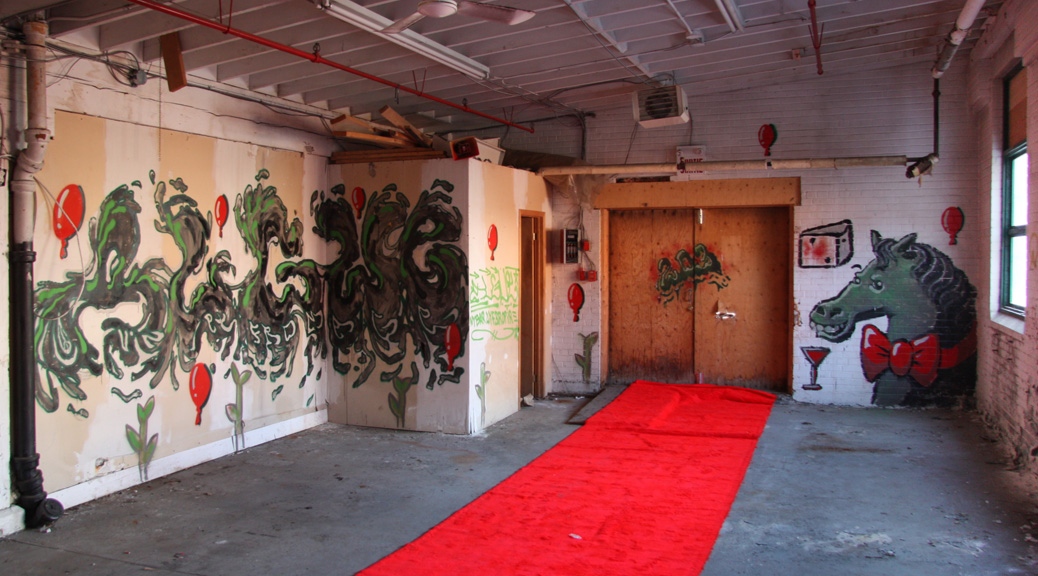
This rather small room with a red carpet may have just been an entrance hall. The carpet seems to have inspired Algue and his mates to come up with this festive theme.
Cette petite pièce avec tapis rouge était probablement un hall d’entrée. Le tapis semble avoir inspiré Algue et les autres à y donner un coté festif.
Algue representing the 203 crew in the abandoned Transco
This room, which featured very little graffiti, was particularly loved by urbex photographers because of the unexpected presence of an old piano.
Cette pièce, où l’on ne trouvait que très peu de graffiti, était très prisée par les photographes d’urbex à cause de la présence inattendue d’un vieux piano.
tagged piano in the abandoned Transco; tags include Nock for RCD, Rizek, Resok, Meth.
Tagged piano; tags include Nock for RCD, Rizek, Resok, Meth.
the machinery room
This was a large room, but most of it was rather dark and offered very little wall space good enough for graffiti. Some of material shown below was actually found inside small adjoining rooms.
Cette pièce était plutôt grande mais peu lumineuse et n’offrait que très peu d’espace intéressant pour y faire du graffiti. Certaines des oeuvres montrées dans cette section ont en fait été trouvées dans de petites pièces attenantes.
This room was only accessible from the outside and wasn’t visited by graffers and photographers until late winter when the demolition teams made a hole in a wall of the orange room (in the middle of Janek’s piece, hence the name I found for this section) to access it from the inside.
Cette pièce était inaccessible autrement que par l’extérieur et est demeurée inconnue des graffeurs et photographes jusqu’à la fin de l’hiver quand les équipes de démolition ont créé une ouverture dans un mur de la pièce orange (dans le milieu de l’oeuvre de Janek) pour y accéder de l’intérieur.
Etos in red and Actor in grey, in the abandoned Transco
Etos in red and Actor in grey. Partly visible on the right is the hole that finally made it possible to explore this room.
Getsa in the abandoned Transco
Two hollows by Getsa.
other
This section brings together whatever doesn’t fit elsewhere: small rooms with only 1 or 2 pieces, storage or delivery areas, nooks, etc.
Cette section compile tout ce qui ne pouvait être présenté dans les autres sections: petites pièces avec seulement 1 ou 2 oeuvres, espaces de rangement ou de livraison, etc.
The image gallery below is presented in reverse chronological order. The most recents pieces are at the top and the ones from the beginning of 2016 at the end.
La gallerie-photo ci-dessous présente les oeuvres en ordre chronologique inverse. Les pièces les plus récentes sont donc au début et celles datant du début de 2016, à la fin.
Behind the building with the legal wall, on Mullins street, is found another wall where graffiti seems to be tolerated. This wall separates a basketball court from a park and is painted on both sides.
Sur la rue Mullins, derrière l’édifice offrant le mur légal, se trouve un autre petit mur où les graffitis semblent tolérés. Ce mur sépare un terrain de basketball du parc adjacent et est peint des deux côtés.
Si vous reconnaissez les artistes responsables de certaines pièces non-créditées dans la galerie-photo ci-dessous, vous êtes invités à m’en faire part.
Northern wall / mur nord
Photos in this image gallery are displayed from the left end to the right end of the wall, then in chronological order within the same spot.
Les photos de la galerie ci-dessous sont présentées de l’extrémité gauche à l’extrémité droite du mur, et ensuite en ordre chronologique pour un même endroit.
Skor (ground level) at the Rouen legal graffiti tunnel
Max and Ogen (bottom) and Gaulois (middle) at the Rouen legal graffiti tunnel
Max (characters) and Ogen (letters). An older piece by Gaulois is still visible above.
Temps (ground) and Gaulois (middle) at the Rouen legal graffiti tunnel
Temps. An older piece by Gaulois is still visible above.
Vapo and Acro representing the VHS crew at the top, plus Saner, Penar, Aces, Slake over Eskro and Apok at ground level
Vapo and Acro representing the VHS crew at the top. Visible at ground level are Saner, Penar, Aces, Slake over Eskro and Apok.
Southern wall / mur sud
Photos in this image gallery are displayed from the left end to the right end of the wall, then in chronological order within the same spot.
Les photos de la galerie ci-dessous sont présentées de l’extrémité gauche à l’extrémité droite du mur, et ensuite en ordre chronologique pour un même endroit.
Bopor (bottom left), Gaulois (bottom right), Hers (middle), Saner (top) and Jest (moon) at the Rouen legal graffiti tunnel
Bopor (bottom left), Gaulois (bottom right), Hers (middle), Saner (top) and Jest (moon).
Kist (bottom), Hers (middle), Saner (top) and Jest (moon) at the Rouen legal graffiti tunnel
Kist (bottom), Hers (middle), Saner (top) and Jest (moon).
Monk.e and Smilé/Smilee, Hers (middle), Saner (top) and Jest (moon) at the Rouen legal graffiti tunnel
Monk.e and Small(?) (bottom), Hers (middle), Saner (top) and Jest (moon).
Peyo (left) and Warek (right) at the Rouen legal graffiti tunnel
Jest over a graffiti piece by Skor at the Rouen legal graffiti wall, visible above is a pink flop by Gaulois and the green creature on the left is by an unidentified artist
Kelen ‘etchitti’ at the Rouen legal graffiti tunnel
Kelen. It’s difficult to see in a photo, but this is actuallly an ‘etchitti’. The letters were not painted. Instead, the flat coloured surface was etched to reveal the colours from earlier pieces. For those who can’t see the letters, don’t worry, this is Kelen’s usual style.
Cafe, Acro and Vapo on the top floor and Hers, unidentified, Vapo, Acro, Slake and unidentified on the ground level, at the Rouen legal graffiti tunnel.
In early April, Cafe, Acro and Vapo from the VHS crew reclaimed their spot on the top floor of the Southern wall of the tunnel. Also visible in the photo on the ground level are Hers, unidentified, Vapo, Acro, Slake and unidentified.









 Wall2Wall Montreal